top of page
Want to have the latest History Notes delivered right to your inbox weekly? Head over to Sign Up for Our Newsletter to get History Notes sent to your email every Thursday morning! 

Updated: Dec 1, 2022

Do these hot summer days have you wishing to cool off with a nice bath? Well how would you feel about these two bathing options from Longmeadow Historical Society's Collection at the Storrs House Museum?


In the days before central air and rotating electric fans, your options for keeping cool were rather limited! And washing off at the end of a long, hot day was hardly refreshing.

Consider this mid-19th "hat tub," so named for its resemblance to a gentleman's hat if you flipped it over. It would have been perfect for a standing bath, but certainly not a long, casual soak. You would stand in the middle and let the soapy water run down into the base of the tub. When finished, you could pour out the dirty water from the spout. The flat surface is not for sitting--it's for your pitcher of water and soap!


ree

Or this pretty English pearlware pitcher and washbowl set (c. 1820-1840) for your bed chamber? The bowl fits within a hole in the top of the washstand made to hold it. Add clean, cool water and freshen up with a linen towel.


ree

ree

Domestic arts expert and Hartford resident Catherine Beecher proclaimed in her 1869 book, The American Woman's Home, bathing to be necessary for maintain one's health, but it needn't be done by immersing ones "whole person" in a large tub: "A wet towel, applied every morning to the skin, followed by friction in pure air, is all that is absolutely needed."


Similarly, Lydia Marie Child in her Family Nurse: A Companion to the American Frugal Housewife recommended that a person should, "Wash your whole person thoroughly once or twice a week; and wash yourself with a coarse crash towel, or brush, till the surface glows. ..If done at night, it is apt to induce refreshing sleep." Refreshing indeed!


Contributed by Melissa M. Cybulski, Board member, Longmeadow Historical Society

Originally published July 30, 2020


Updated: Dec 1, 2022

This History Note introduces us to an 1820's shopkeeper, Irinda Colton, of Longmeadow. She operated her own shop on State Street in Springfield. Love coming across stories of entrepreneurial women like Irinda from so long ago!


Irinda Colton was born in Longmeadow in 1803 to Ebenezer and Phebe Barton Colton, one of 12 children. As an 11-year-old girl, she completed the sampler pictured below (notice her name and age at the bottom).


ree

She became a milliner, or hat maker, and opened a shop in Springfield on State Street "opposite the Armory" with Hannah Booth in 1827. Her shop advertised "Millinery, of the most approved taste and fashion, Among which are,


"Leghorns, black and white,

Sattins, different colors,

Florences do,

Sarsenets do,

Gro de Naps do,

French and Lisse Crapes do,

Fancy, Barage and Cashmere Hdkfs,

Swiss and Mull Muslins,

Brown Cambrick,

Work'd Caps, Capes and Collars,

Thread, Bobbinet and Thule Laces,

Ribbons, a variety,

Hair Puffs and Ringlets,

Head Flowers and Wreaths,

Ostrich Plumes, Gimps, Cords, &c."

Imagine how fashionable the ladies of the area would look with these options!


ree

When she died in Wilbraham in 1870 of typhoid fever, she left an inventory of goods from her business.


ree

Contributed by Betsy McKee, Board Member, Longmeadow Historical Society

Originally published July 23, 2020


Updated: Dec 1, 2022


ree

Mill Road once connected the south end of the Longmeadow Green to the grist mill and the sawmill on Shaker Road. While an 1822 deed in the Longmeadow Historical Society archives is the first reference that we have to the name “Mill Road”, the mills themselves were in business by at least 1809.


Longmeadow was an agricultural community and a grist mill provided an important service to our farmers. Grist mills ground grain between two millstones, converting bulky grain into more portable flour or meal. Farmers could then easily sell the flour or meal. Two millstones in the Storrs House Museum garden likely came from a Longmeadow grist mil.


ree

Sawmills, likewise, served a necessary function in the community, creating boards and planks from logs to help build structures in a growing town.


The saw and grist mills and the general path of Mill Road appear on the 1831 map of Longmeadow. The machinery used what we would today consider a “green technology” – it was powered by water from Longmeadow Brook. Other grist and sawmills, which were powered by the Pecousic Brook at the north end of Longmeadow, also served the residents of Longmeadow and East Longmeadow.


ree

1831 Map of Longmeadow


The mills changed owners several times in the 1800s. In 1850, Newton Colton ran the mills. That year, the grist mill produced 22,000 bushels of meal. The sawmill was equally productive, converting 3,700 logs to 35,000 feet of lumber.


ree

1850 Industrial and Manufacturers Census Schedule


Sometime before 1855, a pond was created in Longmeadow Brook at the site of the mills.


ree

1855 Map of Longmeadow


By 1880, Hamilton Reuben (or Reuben Hamilton) operated the grist mill. The Longmeadow Brook grist mill operated full-time for six months of the year and part-time for three months of the year. A water wheel with an eighteen-foot fall powered the grinding stones and the mill could produce 100 bushels of grain meal or animal feed per day.


ree

1880 Flouring and Grist Mills Schedule

By 1891, Charles S. Allen owned the mills on Longmeadow Brook. The 1894 map shows that the sawmill had been replaced by a knitting mill. Mr. Allen also owned the Old Country Store at 776 Longmeadow Street, the building currently occupied by The Spa on the Green.


ree

1894 Map of Longmeadow

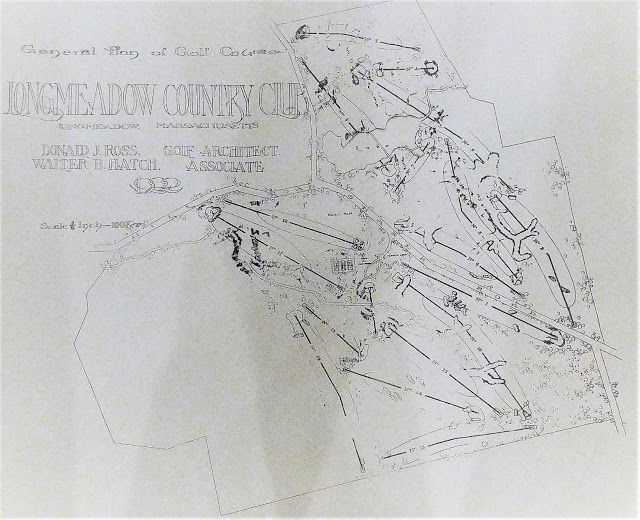
As the character of Longmeadow transitioned from a farming community to a suburban community in the early 1900s, Longmeadow residents no longer needed a grist mill and the mills were torn down. In the 1920s, the pond of Longmeadow Brook was incorporated into the Longmeadow County Club golf course; it is now known as Country Club Pond and is labeled on the 1922 plan below as “Lake”.


ree

“General Plan of Golf Course”- Donald J. Ross and Walter B. Hatch


Today, you can drive on Mill Road only from Longmeadow Street to Brookside Drive. While the path from Brookside Drive to Shaker Road still exists, it is no longer paved or maintained by the town.


ree

The intersection of Brookside Drive and Mill Road

Sources: 1831 Map of Longmeadow, 1855 Map of Longmeadow, 1894 Map of Longmeadow 1850 Industrial and Manufacturers Census Schedules 1880 Flouring and Grist Mills Schedule 1891 Valuation Report Longmeadow Historical Society Archives “General Plan of Golf Course,” Donald J. Ross and Walter B. Hatch, 1922 (Longmeadow Country Club Archives)


Contributed by Elizabeth Hoff, Longmeadow Historical Society Board Member

Originally published July 16, 2020


Contact

Contact us to learn more about our collections, upcoming events, and visiting the Storrs House Museum.

Address

697 Longmeadow Street Longmeadow, MA 01106

  • Facebook
  • Instagram
  • X

413-567-3600

© 2025 by Longmeadow Historical Society. 

Address: 697 Longmeadow Street 

Longmeadow, MA 01106

Email: info@longmeadowhistoricalsociety.org 

Phone: (413) 567-3600 

The contents of this website are the property of the Longmeadow Historical Society and may only be used or reproduced for non-commercial purposes unless licensing is obtained from the society.

The Longmeadow Historical Society is a 501(c)(3) charitable organization

bottom of page