top of page
Want to have the latest History Notes delivered right to your inbox weekly? Head over to Sign Up for Our Newsletter to get History Notes sent to your email every Thursday morning! 

Updated: Dec 1, 2022

Longmeadow is filled with numerous majestic historic homes. The tales of many of these homes are well known. Other homes have fascinating histories that could become forgotten. Two such magnificent homes are the Page/Wallace (Deepwood) and Robinson Estates. These two homes are located on the Bay Path University campus.


ree

The property where Bay Path University is currently located was originally part of the Ethan C. Ely property. His ancestor Jonathan Ely settled in the precinct of Longmeadow in 1694. The Ely estate had remained in the family since 1758. Ethan and his father built a brick home with stone trimming in 1856. He was listed in the town directory as a farmer. The natural beauty of the property was carefully preserved and filled with a variety of trees and thus referred to as “Ely’s grove”.


ree

Ethan C. Ely


ree

Ely’s Grove early 1900's


ree

Ethan Ely's Home 1908


Ethan C. Ely died in 1906. He had no direct heirs as his wife had died 40 years previously and his two children died early in life. The property was eventually sold to J. B. Burbank, a neighbor and real estate entrepreneur. The property was then sold to George Hendee (owner of Indian Motocycle) upon his retirement. He did stake out land to build an estate as indicated on the 1912 Longmeadow map.


ree

Mr. Hendee never built this home and instead built a palatial estate in Suffield, CT. The property was then sold to Frank Page and his estate was built at 588 Longmeadow Street.


ree

Mr. Page was the wealthy owner and founder of the National Equipment Company in Springfield.


ree

Mr. Page


ree


ree

Page's home was completed in 1917. The Georgian Colonial at the time was one of the largest and most expensive homes in Longmeadow. The estate included a home for his chauffeur and gardener.


ree

Frank Page sold the home to Douglas V Wallace in 1927. The estate became known as Deepwood. Mr. Wallace was a member of the Wallace family who owned and operated Forbes and Wallace department stores. The store chain existed in the area from 1874-1976.


ree

Mr. Wallace unfortunately died at 44 years old in 1930. His wife, Mary Wallace, who lived to 106 years of age, retained ownership. Her father, John C. Robinson, purchased an adjacent property. Mr. Robinson was a wealthy realty company executive who donated the land in Agawam that eventually became Robinson State Park. His daughter Mary resided with him at the mansion built at 544 Longmeadow Street. It would also become part of the Bay Path campus. Deepwoods at 588 Longmeadow St. was sold to W. J. Quinn Company in 1940 for real estate development. There was a plan to build 15 homes on the site.


ree

Robinson mansion, adjacent to Wallace estate. Today part of Bay Path campus. Due to World War II these plans never came to fruition. The National Youth Administration (NYA) leased the home in 1942 to serve as a residence and center for women working in the defense industry during World War II.


ree

Deepwoods was sold to Thomas Carr in 1945. Mr. Carr had purchased Bay Path Institute in 1944 and moved the school from Springfield to the eighteen-acre estate in 1945. The Robinson Estate was purchased by Bay Path in 1947 with money donated by George Empsall (Mr Carr’s brother-in-law) to be used as a dormitory.


ree

Today Deepwoods Hall at Bay Path University

is the main administrative building.


ree

The Robinson mansion is presently Empsall Hall which houses the admissions offices


Contributed by Leonard Shaker, Longmeadow Historical Society Board Member

Originally published February 17, 2022


Updated: Dec 2, 2022


ree

Cover of The Poets' Album compiled in 1864 for the Brooklyn Sanitary Fair; from the collection of the Longmeadow Historical Society


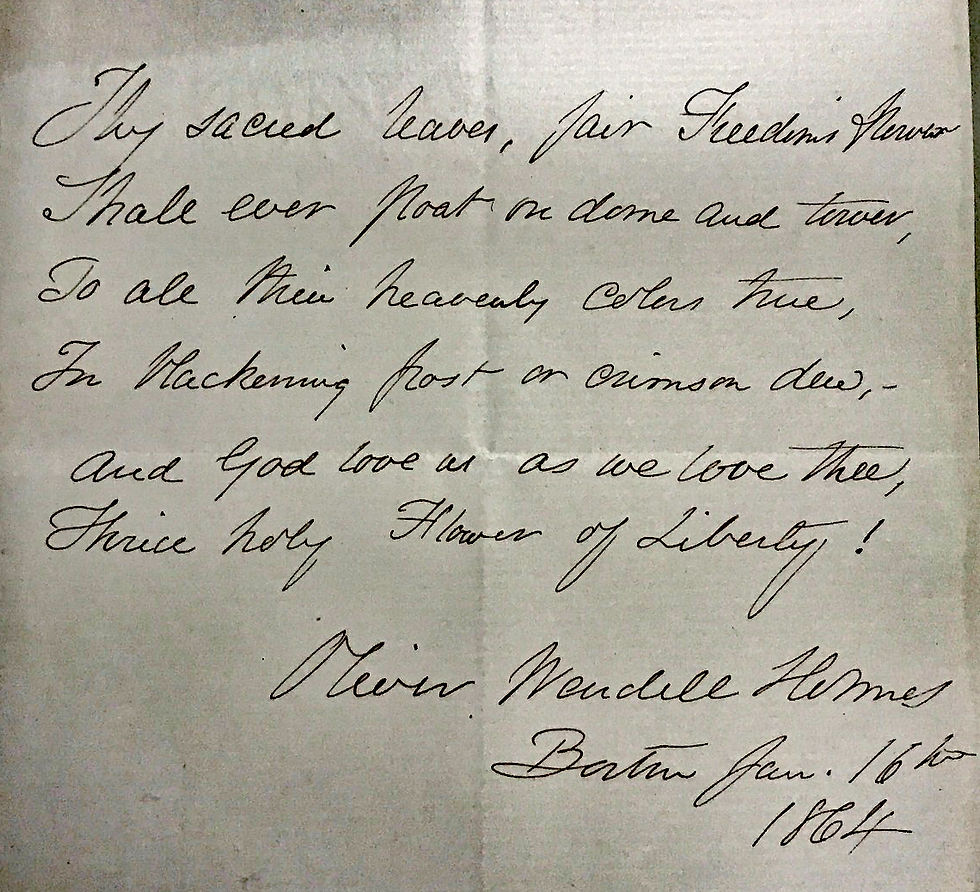
I wanted to share the item in our collection at the Longmeadow Historical Society that first helped me begin to piece together the connections between one of the world’s most celebrated poets and two cousins who shared a name and a deep connection to Longmeadow.


If asked to pick my favorite piece in our collection at the Storrs House Museum, without a doubt I would pick this 1864 “Poets' Album” containing handwritten and autographed poems and poem excerpts submitted by prominent 19th-century poets and writers. The writings were contributed to raise money for the Brooklyn Sanitary Fair, a fundraiser organized to benefit wounded Union Soldiers during the Civil War.


ree

Hand-drawn and colored Title Page


The Brooklyn Sanitary Fair took place over two weeks in February and March of 1864 at the Academy of Music in Brooklyn, NY. It was an enormous affair featuring entertainment, food, art displays, and vendor booths selling countless donated items to help ease the burden of soldiers who were wounded fighting for the Union cause. It is estimated that Fair raised $300,000 (equivalent to $5.1 million today) for the Union soldiers.


ree

ree

ree

ree

ree

ree

ree

ree

ree

ree

Contributed by Melissa M. Cybulski, Longmeadow Historical Society Board Member

Originally published February 10, 2022


ree

During the years that followed the second world war, many white Americans experienced unprecedented prosperity in large part due to programs like the GI Bill that enabled them to more easily purchase homes than ever before. Unfortunately, their fellow black citizens were frequently denied these same opportunities. Massachusetts Commission Against Discrimination (MCAD) was a state body created in 1945 to enforce state-level anti-discrimination laws, its 1965 Annual Report indicated that several Longmeadow citizens both participated in and fought against this disgraceful practice.


ree

In February of 1965, David Duncan III, a 40-year-old African American WWII combat veteran and manufacturing engineer at Pratt and Whitney, was looking to purchase a home when he came across a listing in a local newspaper for 24 Pine Hill Road in Springfield. Mrs. Duncan called the listing agent, Robert J Flynn, who was operating his real estate business, the Robert J. Flynn Real Estate Agency, out of his house in Longmeadow. During the phone conversation, Flynn informed Mrs. Duncan that the house was for sale for a price of $21,500 (about $190,000 in October 2021 dollars) and they agreed to meet on February 6th so the couple could see the house. After touring the house, Flynn informed the Duncans that the price of the house was $25,000 (about $221,000 in October 2021 dollars). When Mr. Duncan protested that the real estate broker had told his wife over the phone only a few days earlier that the price was only $21,500, Flynn retorted that his wife must have misheard him.


A little more than a week after the showing with the Duncans, Mr. Flynn received a call from Elizabeth Grandison, a white woman, also asking to see the house for sale. Unbeknownst to Flynn, David Duncan III had contacted MCAD to file a complaint about his experience trying to purchase 24 Pine Hill Road and the Commission had sent Mrs. Grandison to “test” Duncan’s claims. Ms. Grandison was a member of the Springfield Urban League and a civil rights activist from Longmeadow. She inquired about seeing the house and Mr. Flynn offered to show it to her that day. After touring the house, Flynn informed Mrs. Grandison that the house was priced at $21,500 but he would be willing to accept an offer as low as $20,000 (about $177,000 in October 2021 dollars).


After the showing, Mrs. Grandison reported back to MCAD and informed them of the results of the showing and confirmed the charge of discrimination. Based on Grandison’s and the Duncans’ testimony, MCAD Commissioner and Longmeadow resident John F. Albano, filed an injunction against Flynn in Hampden County Superior Court in order to prevent Flynn from selling the house to anyone except Duncan. Albano had been appointed to the commission in 1964 and concurrently served as president of the Springfield-Chicopee-Westfield AFL-CIO. Albano brought his nearly 30 years of experience fighting against unfair labor practices and used it to fight against racial discrimination.


In court, Flynn’s attorneys along with those of the property owner Jean C. Tierney argued that they should be permitted to sell the house because Mr. Duncan was misrepresenting the facts. They asserted that they had an asking price of $25,000 and were only willing to go as low as $21,500 and that the Duncans had told Flynn that the highest they were willing to pay was $20,000. The Duncans reiterated their story of the phone pricing vs. the in-person pricing. Judge Francis L. Lappin attempted to mediate and try to have the two parties come to an agreement. However, when it was apparent that the defendants were not going to come down in price low enough for the Duncans, he dismissed the injunction request allowing Tierney and Flynn to go about their business of selling the home.


ree

While MCAD had failed to force the house in question to be sold to the Duncans, the commission still needed to have a public hearing to assess if discrimination had taken place. On September 20, 1965, with the benefit of both Duncan and Grandison’s testimony the MCAD commissioners Malcolm C. Webber, Ben G. Shapiro, and Ruth M Batson found Robert Flynn guilty of housing discrimination. MCAD subsequently ordered Mr. Flynn to stop discriminating against anyone he interacted with as part of his real estate business, he must include in all of his newspaper advertisements for his real estate business that they were “Equal Rights” listings and he was required to report in writing the steps he had taken to comply with the order to MCAD.


After the ruling, in October of 1965, Flynn sued MCAD to obtain a restraining order to prevent the ruling from going into effect. In February of 1966, Judge Joseph Ford ruled that Flynn needed to comply with the order. As a result, Flynn placed the ads like the one pictured.


ree

In April of 1965, Elizabeth Grandison and her husband sold their house in Longmeadow and moved to Boston.


As for Mr. Duncan, in the years following the decision, he did successfully purchase a home in Springfield, MA where he lived until he passed away at the age of 80 in 2005. Duncan found much success and was a fixture in the Springfield community in the 40 years following the decision. He received numerous awards including the “Eyes on the Prize'' award in 1996 from WGBY and induction into the Black and Gold Society of his alma mater the Wentworth Institute of Technology. He was a member of the VFW, was very active in the Freemasons serving in numerous roles over the years, treasurer of the Alden Street Baptist Church, and on the Board of Directors of both the Dunbar Community Center and the Springfield Girls Club Family Center. Perhaps most notably, Duncan served as the first African American on the Springfield Police Commission and served as Chairman during the period of civil unrest following the assassination of Dr. Martin Luther King, Jr.


Albano continued to serve as an MCAD commissioner until 1969. After the end of his time on MCAD, he continued to play a large role in the labor movement in Western Massachusetts. In Longmeadow, he spent many years serving the Jewish Home for the Aged. When he died in 1979, his funeral had over 500 mourners in attendance and included political and labor leaders from across the state.


Mr. Flynn continued to operate his real estate business in Longmeadow after the MCAD decision until his death in 1969. Flynn never gave a reason for discriminating against Mr. Duncan, specifically declining to comment to the press after MCAD’s decision. The behavior that Flynn and others like him displayed created a system that denied black people the ability to equitably purchase a house.


This practice affected black homebuyers in the mid-20th century and this lost economic opportunity was passed on to their children and their children’s children. For example, if Mr. Duncan had been able to purchase this house at a price of $20,000 and then sold it today for Zillow’s current estimated value of $254,000, he would have made an inflation-adjusted profit of about $77,000 which he could then pass on to his children and/or grandchildren. In 1968, Congress passed the Fair Housing Act (FHA) which enshrined equal housing opportunity at the federal level and provided federal enforcement mechanisms to combat housing discrimination which were much more of a deterrent than most state anti-discrimination laws. While the work that David Duncan III, John Albano and Elizabeth Grandison combined with the passage of federal legislation, certainly has improved the housing discrimination situation, inequities and discrimination are still very much a problem all over this country and even in our region. That is why, if you are living in Massachusetts and feel you have been a victim of discrimination, you can contact MCAD either by phone at (413) 739-2145 or by email at mcad@ma.gov and if you are living anywhere in the USA and you feel you have been the victim of housing discrimination, please contact the Department of Housing and Urban Development either by phone at (800) CALL-FHA (800-225-5342) or by email at answers@hud.gov


Special thanks to the Hampden County Clerk of Courts staff for their assistance with this research.

Sources

  • America, United States of. “CPI Inflation Calculator.” U.S. Bureau of Labor Statistics. U.S. Bureau of Labor Statistics, 2021. An Exceptional Opportunity, Robert J. Flynn Agency.

  • An Exceptional Opportunity Springfield Union, March 13, 1966.

  • Assessors, Springfield. 24 Pine Hill Road. Photograph. Springfield Assessors Database. Springfield, MA: Springfield Assessors, April 29, 2016. Duncan, Tracy.

  • Mr David Anderson Duncan III, 80 The Republican. July 28, 2005.

  • Flynn, William. Robert J. Flynn, Realtor, Dies Springfield Union News, July 25, 1969. Hampden County, Massachusetts Deed Book 3105: 128

  • Springfield, and Malcolm Webber, ANNUAL REPORT of the Massachusetts Commission Against Discrimination January 1, 1965 to December 31, 1965 § (1966).

  • Springfield Union, The (Massachusetts) 25 February 1965, Flynn Is Cleared, GenealogyBank.com

  • Springfield Union, The (Massachusetts) 3 March 1966, Realtor is Told to Comply with MCAD Order, GenealogyBank.com

  • Springfield Union, The (Massachusetts) 18 November 1966, Virginia Meyers Marries Lt. Wilfred Grandison, GenealogyBank.com

  • Sunday Republican, The (Massachusetts) 11 November 1979, John Albano Hailed as a Friend in Need, GenealogyBank.com

  • Zillow, Inc. 24 Pine Hill Rd, Springfield, MA 01118.” Zillow, 2007.

Contributed by Tim Casey, LHS Board Member

Originally published February 3, 2022


Contact

Contact us to learn more about our collections, upcoming events, and visiting the Storrs House Museum.

Address

697 Longmeadow Street Longmeadow, MA 01106

  • Facebook
  • Instagram
  • X

413-567-3600

© 2025 by Longmeadow Historical Society. 

Address: 697 Longmeadow Street 

Longmeadow, MA 01106

Email: info@longmeadowhistoricalsociety.org 

Phone: (413) 567-3600 

The contents of this website are the property of the Longmeadow Historical Society and may only be used or reproduced for non-commercial purposes unless licensing is obtained from the society.

The Longmeadow Historical Society is a 501(c)(3) charitable organization

bottom of page