top of page
Want to have the latest History Notes delivered right to your inbox weekly? Head over to Sign Up for Our Newsletter to get History Notes sent to your email every Thursday morning! 

Updated: Dec 1, 2022


ree

If you had driven down Longmeadow Street around the turn of the 20th Century, you would have definitely noticed the Medlicott house at 720 Longmeadow Street. This imposing home caught the eye of Longmeadow photographer Pasiello Emerson and he photographed it many times.


While we refer to the building as the “Medlicott house”, Mr. Medlicott was not its first owner. Captain Calvin Burt, a merchant in Longmeadow, built the house around 1786 near the north end of the Longmeadow green. A contemporary of the Richard Salter Storrs house (now the Storrs House Museum), the Calvin Burt house was situated just north of what is now the Brewer-Young Mansion.


ree

Capt. Burt passed away in 1848 and William G. Medlicott, a woolen stockinette manufacturer, purchased the house from the Burt estate in 1851.


ree

William G. Medlicott courtesy of Stephen Forbes


Mr. Medlicott, his wife, and his five children lived in the Burt house and, by 1864, he had substantially remodeled the house. Last summer, a descendant of the Medlicott-Allen-Kibbe family shared a collection of family photographs with the Longmeadow Historical Society; included in the collection is an image of the Calvin Burt house before it was remodeled.


ree

ree

In addition to altering the façade of the building, William G. Medlicott substantially enlarged it. It is likely that Mr. Medlicott needed the extra space to hold his 20,000 volume private library. On the 1910 map of Longmeadow, the home looks comparable in size to its neighbor to the south, the Brewer-Young Mansion. The map shows a barn behind the house, and there was also a garden. The view from the back of the house stretched westward to the Connecticut River.


ree

1910 Map of Longmeadow


ree

William G. Medlicott died in 1883 and probate records show that he left all of his properties to his daughter, Mary.


ree

Eliza Medlicott continued to live in the house with her daughters Mary and Bertha until she died in 1907. Son William B. and his family moved back to the Medlicott house after his mother’s death and they lived there with Bertha and Mary until William B. and his family moved to Cambridge. In 1916, Bertha moved to Northampton and Mary moved to Springfield.


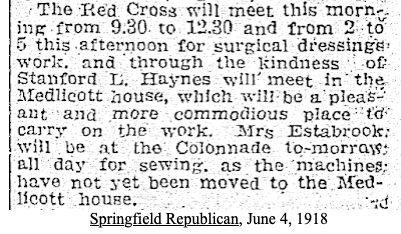
In 1917, Stanford L. Haynes, the neighbor who lived just north of the Medlicott house, purchased the house and, in 1918 and 1919, it became the headquarters of the Longmeadow chapter of the Red Cross.


ree

Stanford L. Haynes died shortly afterwards and, according to a 1921 article from the archives of the Longmeadow Historical Society, his estate sold the Medlicott house, but not the property, to Charles N. Dunn, president of Bay State Storage and Warehouse Company. Mr. Dunn planned to use elements of the house in his “fine new residence” on Sunset Road, overlooking the river, at the south end of Longmeadow. Unfortunately, Mr. Dunn subsequently had financial difficulties and I can find no record that he ever built his new home.


ree

1921 newspaper article


The Medlicott house was torn down and it disappeared from Longmeadow over 100 years ago, but we are fortunate that we have so many images which document the grandeur that it once represented.

Sources

  • Special thanks to Stephen Forbes and James Moran

  • Longmeadow Historical Society archives

  • Hall, J. R. 1990. William G. Medlicott (1816-1883): An American book collector and his collection. Harvard Library Bulletin 1 (1), Spring 1990: 13-46. William G. Medlicott (1816-1883): An American book collector and his collection (harvard.edu)

  • Springfield Republican, June 4, 1918

  • "Use Materials in Old House," 1921 newspaper article

  • “Miss Medlicott, Librarian, Dies at Age of 81,” Springfield Republican, March 3, 1927

  • Massachusetts, U.S., Wills and Probate Records, 1635-1991

  • 1831 Map of Longmeadow

  • 1910 Map of Longmeadow

Contributed by Elizabeth Hoff, Longmeadow Historical Society Board Member

Originally published March 10, 2022


Updated: Jul 22, 2024


ree

ETA: This 2022 article by an LHS Class of '22 graduate was the culminating project for an internship he completed as part of his coursework. We are grateful to Christopher Cummings for his contribution.


The sculpture was donated to the Longmeadow Historical Society by the siblings of Lane Ziff, a long-time Storrs Library employee who passed away in March 2021. It had been in their family's collection since their parents acquired it many years ago.

*****************************************************************************************************************************


Hello, everyone. I’m Christopher Cummings and I’m a senior at Longmeadow High School. I’ve been interning at the Longmeadow Historical Society for about 3 months now. The task I have been given is to learn about, reflect on and tell the story behind a recently acquired gift to the museum. The gift is a statue called Deerfield by sculptor Jud Hartmann. I’ve become absolutely fascinated by the story of the 1704 Raid at Deerfield that is depicted in the statue. It depicts three native men attacking Englishman John Sheldon's door. This was an actual event that happened during the 1704 raid. Since I'm personally a huge fan of colonial history and native interactions I naturally felt interested in this piece. This story is important to Longmeadow’s history because our first minister, Rev. Stephen Williams was captured and marched to Canada during the raid. He was only a young boy at the time.


The statue tells the story of the French and Native raid on the northernmost English settlement of Deerfield in 1704. As a part of the Spanish Succession War, the French sought to defend their colony, New France, against the larger and more populated New England. Although not much fighting occurred in the colonial territory, the French figured it would be best to strike first, before the English continued to expand their colonial territories.


ree

ree

ree

To take the initiative against the English, the French went on the offensive, using their native allies to their advantage. The raiding party was diverse, being made up of not only French soldiers, but members of several different native tribes. France attempted to bring many different native groups together and maintain alliances by launching a joint raid on Deerfield.


These natives were the Abenaki, Huron, Iroquois, Mohawks and Pennacooks, each with their own reasons for participating in the raid. The Abenaki and Pennacook supported the French, as they had already been struggling in a series of wars with England that hadn’t been going their way. The Hurons and Iroqouithen-ten-year-olds, in a tradition known as “mourning wars,” fought to bring captives to make up for the loss of dead family members. The Mohawks fought for this same reason as well, except allegedly with the notable extra motivation of reclaiming a lost bell they had bought from the French that was stolen by the English. From the website of the Pocumtuck Valley Memorial Museum in Deerfield I learned, “Kanienkehaka oral tradition tells that in Deerfield the Kahnawake raiders hoped to find a church bell that had been purchased by the people of Kahnawake and transported on a French ship from Europe. According to this tradition, the bell was stolen en route by English privateers and later bought by John Williams.” With all these parties combined, the raid was one of the most diverse attack parties ever assembled on the continent up to that point. See reference for additional information.


In 1703, a few months before the raid, the English actually had good reason to believe there would be an impending attack. English forces spotted the raiding party outside Fort Chambly on the Richelieu River. The English sent forces to reinforce Deerfield before the raid. However, as months passed and nothing happened the English militia departed. Aside from repairing the palisade and building a few minor fortifications, the English were caught vastly underprepared when the raid occurred in February 1704.


John and Stephen Williams


Two of the most famous individuals from this raid were Deerfield residents, John and Stephen Williams. John Williams (1664-1729) was a Deerfield minister. In 1706 his release was negotiated and he was returned to New England. However, he wasn’t happy to hear that his then ten-year-old daughter, Eunice, refused to come home with him. She instead stayed with the Mohawk family who had adopted her, and joined their tribe by marrying François-Xavier Arosen, or Amrusus, a Kanawake. When John Williams returned home he wrote and published a memoir of his experience, The Redeemed Captive, in 1707. It became one of the most popular captive retellings of its time.

Stephen Williams (1694-1782), the son of John Williams was only 10 years old when he was captured in 1704. He, too, recounted his experience in a handwritten account of his experience.


ree

After the events depicted in the statue, the captured residents of Deerfield, including Stephen and John Williams, were forced to march this route in cold and brutal winter conditions.


ree

The Sculpture


In the sculpture we see three natives attempting to break down the Sheldon house door. The actual door still exists and is on display at the Pocumtuck Valley Memorial Association Museum in Deerfield. It still displays the hatchet marks and has been referred to as “The Old Indian Door” for generations now. John Sheldon and his family lived in Deerfield at the time of the raid. Although they ended up being captured, their reinforced door came to symbolize English strength during the raid. The attackers were ultimately able to get in by sneaking through the back, after failing to break down the door.


Per Jud Hartmann, the sculptor of the statue, each native figure represents a different tribe. The native man closest to the door with a raised hatchet is an unnamed Abenaki raider.


However, the other two native raiders are some of the most impactful characters of the Deerfield story.


I learned through an email correspondence with Mr. Hartmann, the native man in the middle who appears to be in full motion is named, “Amrusus, a Caughnawaga Mohawk, wearing an Iroquois deerskin jacket with a distinctive double fringe down the back. He later married Eunice Williams.” Eunice Williams, John Williams' daughter, would ultimately choose to live with the native society that she had been adopted into rather than return home to New England.


Hartmann also said the second Native American is one by the name of “Thaovenhosen, the Huron chief who was a key & important ally of the French who lived close to Quebec in the Huron village of Lorette. Signifying his importance & close ties to the French, he is wearing a French army officer’s great coat which he would have received as a gift.” The French supplied arms and other equipment to their allies, and through Thaovenhosen’s appearance we can see that.


Is it fair to say this piece is controversial? Yes, of course, it is. As with many things in history, it's difficult to really define what a piece means to some people. To one person looking at this statue, you might see a “Barbarians at the gate” scenario, in which a door stands alone to keep out “savagery.” However, to another person, they could see an accurate representation of native cultures in action, albeit not a very friendly action - but nonetheless a correct retelling of what happened. Others can see it as a complete fabrication, but that's not for me to decide. Anyone is open to interpreting a piece any way they like as after all, no one OWNS history. Part of the point of art like this is to retell history and illustrate the way some see it. So it's not wrong for someone to interpret this piece as controversial. When people in the future look back on the past art is one of the most widely interpretable things.


ree

Personally, I feel like I’ve learned a lot about not only European conflict and colonial history, but a lot more about native cultures at the time. It’s something that isn’t generally taught unless you take a specific class relating to it. I can say as a high school senior that even though I took AP US History alongside all the other highest-level history classes, I never spent an extended period of time learning about native cultures. The extent that we learned about natives in AP was effectively “All right, Jackson went and removed them all on the Trail of Tears, some of them resisted but they all eventually gave in.” The only tribes I recall from that class are the Cherokee and the Chickasaw, and that's because of the Trail of Tears. Native culture isn’t appreciated for what it is in any way shape or form, and doing a project that's centered entirely around it has been a great learning experience for me.

Questions for Further Thinking

  • How would an early 1700s French Canadian describe this piece? How would an Abenaki, or a Deerfield resident of the time respond if they saw it?

  • How would you describe this piece? What feelings does this statue provoke in you, why?

  • If this statue was sculpted from the perspective of each of the parties represented what changes would be made? Would anything look different?

  • Do you believe this depiction is fair? Why or why not?

  • Does anything in the sculpture stand out as particularly symbolic?

  • Do any particular parts of the natives' attire and outfits stand out to you, such as hair, face paint, or body paint?

For information on the artist, Jud Hartmann, visit his website at https://judhartmanngallery.com.

Works Cited

Note: In the Fall of 2021 the Longmeadow Historical Society was asked to host a student intern from Longmeadow High School. Christopher Cummings '22 spent some time with us with the task of helping us learn more about a recent donation to the Longmeadow Historical Society: a sculpture by Jud Hartmann depicting one incident in the event known as the 1704 Raid on Deerfield. The event has ties to Longmeadow in that our town’s first minister, Stephen Williams, was captured and held for ransom as a result of the attack. We plan to make use of the sculpture to generate discussion about different perspectives over time and across cultures. We are proud of Christopher for the work he has put together here to get us started.


-Contributed by Christopher Cummings, Longmeadow High School '22

Originally published March 3, 2022


Updated: Dec 2, 2022

I found a gravestone in my basement! What would you think if you found a gravestone in your basement? This happened to a new owner of an old house in Longmeadow. He found several fragments of an old marble gravestone being re-purposed as support for a rusting water heater. He dusted it off to read the name: Levi E. Taylor.


ree

Levi E. Taylor, died August 11. 1858


Goosebumps rising, he wondered;


As we moved an old rusted-out water heater, we found some of these fragments. They were used to hold up that water heater.


What am I to learn from this:

  • I hope Levi is not buried in my house for obvious reasons haha. - What do I do with something like this?

  • Any restrictions from me touching this anymore? I only moved them into this spot here to see what it was.

  • Any recommendations on a priest to bless the house? Love history as much as the next person, just not big on potentially spooky things

So being a sensible person, he contacted the Longmeadow Historical Society and the Longmeadow Cemetery Association. These inquiries both landed on this author's lap, since I am a board member of both organizations. We told him that it was very unlikely that Levi was buried in his basement, that the Cemetery Association would take possession of the stone, and that we had no recommendations for blessings.


So, as many historical inquiries come about by chance, we dug into the story. A quick check of the cemetery photos revealed that Levi has a stone in the cemetery, slightly different style, but with the same information.


ree

Levi E. (Ely) Taylor, died August 11. 1858

Not only is there a stone for Levi in the cemetery, but also one for his wife Laura, his mother, children and many other Taylor cousins. It seems logical that some disaster befell Levi's original stone, and a replacement stone was created. Perhaps Laura had that done, since she passed away a couple years after Levi. We also considered whether the broken stone could be a footstone. Early gravestones were almost always purchased as a pair--headstone and footstone--like the headboard and footboard for a bed. Footstones are usually smaller, simpler versions of the headstone, often with just initials and the year. This broken stone is a bit too complete for a typical footstone, and footstones had mostly fallen out of favor by 1858.


ree

So, we have established that the broken stone found in the cellar was probably put there after it was damaged and replaced. So, is it likely that a body was buried in anyone's basement? What about in winter, when digging in the cemetery would be difficult? We consulted with an expert, Tom Kelleher of Old Sturbridge Village. He thought a basement burial would be quite unlikely, partly because a basement, or root cellar, would not be cold enough. Some towns had a town crypt where bodies could be kept until spring burials, but there is no evidence of Longmeadow ever having one. There are many towns, usually smaller, more rural ones, that have multiple small family burial plots rather than just one central cemetery. Again, Longmeadow did not--we had one central graveyard, and then later several others in the "East Village" which became East Longmeadow.


Okay, so the next question in our quest for answers is what was Levi Taylor's stone doing in Jabez Colton's house? Jabez Colton built his house in 1786. His son Elijah was born in the same year. Elijah married Olive Taylor. So now we have a Taylor connection in the Jabez Colton house! Levi Ely Taylor was a first cousin of Olive's. So, we have a family connection, but we don't know that Levi ever lived in that house. In fact, Levi and his son Newton Ely Taylor were both listed as wheelwrights in the 1855 state census, and several maps (1831, 1855) show him living at the corner of Longmeadow Street and Williams (where First Church now stands). There were several structures in this location, as First Church was still located on the green. First Church wasn't moved to the current location until 1874.


ree

Levi Taylor's signature on an 1821 letter in the LHS archves


ree

1831 map, showing Levi Taylor's house Corner of Longmeadow Street and Williams Street


So has our trip "down the rabbit hole" answered our new homeowner's questions? I think so; the stone is in the basement because it was unneeded, Levi was related to the Coltons, and he is buried in the cemetery with other members of his family. The Cemetery Association will accept the pieces and investigate whether they can be reassembled. The only item we didn't help with was the blessing--anyone have any suggestions?


If anyone has any gravestones on their property--often footstones were discarded--please contact the Cemetery Association to have them restored to the graveyard. We are replacing footstones when they are found (often buried in the cemetery). Thanks!


Contributed by Betsy McKee, Longmeadow Historical Society Board Member, Longmeadow Cemetery Association President.

Originally published February 24, 2022


Contact

Contact us to learn more about our collections, upcoming events, and visiting the Storrs House Museum.

Address

697 Longmeadow Street Longmeadow, MA 01106

  • Facebook
  • Instagram
  • X

413-567-3600

© 2025 by Longmeadow Historical Society. 

Address: 697 Longmeadow Street 

Longmeadow, MA 01106

Email: info@longmeadowhistoricalsociety.org 

Phone: (413) 567-3600 

The contents of this website are the property of the Longmeadow Historical Society and may only be used or reproduced for non-commercial purposes unless licensing is obtained from the society.

The Longmeadow Historical Society is a 501(c)(3) charitable organization

bottom of page