top of page
Want to have the latest History Notes delivered right to your inbox weekly? Head over to Sign Up for Our Newsletter to get History Notes sent to your email every Thursday morning! 

Updated: Dec 1, 2022

"The Granny Tale: The Process of Discovering the Truth Behind the Note"


As some of our readers will recall, we recently discussed so called "granny notes," those scraps of paper that claim to know the details of a treasured object and how it came to be in the collection of the Historical Society. Last time we explored the illustrious history of a ceramic bough pot that was purported to have come over on the Mayflower (and was in reality two centuries too young). This week we will explore the story of the Indian baskets.


ree

2014-007, Native American splint basket with side handles, hand decorated in red and black with hearts and medallions, southeastern New England, mid 19th century. Photograph by Lorraine German.


The Longmeadow Historical Society has a wonderful collection of baskets, many paint decorated. They range in size, shape and use. A review of 18th and early 19th century probate inventories from Longmeadow showed that about a half of households listed baskets. They were used for many purposes, including produce, textile production, and food storage. In the 1785 probate inventory of storekeeper Samuel Colton, a group of baskets is listed.


ree

Samuel Colton probate inventory, BV 3 Longmeadow Historical Society archives


In another ledger belonging to Samuel Colton, a Timothy Pease of Enfield is credited for repairing baskets. That says a lot about the utility of the humble basket--everyone used them, and many farmers and their families made them, and they were worth repairing.


ree

Samuel Colton ledger, BV 21 Longmeadow Historical Society Archives


In fact, the baskets in the Storrs House were supposedly made by Eunice Williams (1696-1785), the "unredeemed captive" from the 1704 raid on Deerfield, Massachusetts. On February 29, 1704, French and their Native American allies raided the outpost town of Deerfield, carrying 112 captives to Canada. Among those captives was a teenaged Stephen Williams (1693-1782), who later became Longmeadow's first minister. His seven year old sister Eunice was also taken, and unlike Stephen and other members of the Williams family, she was not "redeemed" or ransomed back. She remained with her native captors, later marrying a Native man named Arosen. Decades later Eunice visited her brother Stephen in Longmeadow. She was wary of potential efforts to return her to her brother's care, and famously refused to sleep under his roof, preferring instead to camp in the nearby orchard.


ree

2014-003.a

photo by Lorraine German


ree

014-006, rectangular Native American splint basket, hand decorated in Mohegan pink and blue, southeastern New England, photo by Lorraine German


A list of objects in the Storrs House Museum was compiled in 1930 by Lucy J. Smith. In that book is a reference to the baskets: "A Collection of a half dozen baskets, said to be the work of Eunice Williams and her Indian family when visiting her brother, the Rev. Stephen Williams (Deerfield has in its Memorial Museum a number of baskets of this kind)." The Pocumtuck Valley Memorial Association's Memorial Hall Museum does indeed have at least one basket made by one of Eunice's descendants. In 1837, a group of Abenakis from Canada visited Deerfield. Sophie Watso, one of the visitors, gave a basket to Catherine Williams. Catherine noted "Basket given me September 1837 by Sophie one of the St. Francis Indians Connected with the Williams family." (Historic Deerfield Magazine Pocumtuck, Autumn 2020).


In 1992, a exhibit of baskets was shown in the Storrs Library. The description of the display is as follows: "Shown here are baskets and Indian items woven by Mrs. Chicklas' grandmother and given to her and her daughter. Claudia Chicklas and her daughter are direct line descendants from Eunice Williams and her Canadian Abenaki Indian husband. Also exhibited are baskets from the Storrs House Collections. Eunice brought several with her when she visited Longmeadow in 1756. Notice the colors and painted paw prints."


Several years ago, the LHS board enlisted the assistance of a local antiques expert to examine the basket collection. We discovered that many of the baskets appeared to be Native American made. Were any of them from the time period or area that would tie them to Eunice? Further study may help us to determine whether the style, decoration, method of construction and materials corroborate this story. Stay tuned as we learn more.


Contributed by Betsy McKee, Longmeadow Historical Society Board Member

Originally published June 17, 2021


Updated: Nov 8, 2023

This week, as many families with school-aged children are wrapping up another busy week, let us pause and recognize the struggles undertaken by many parents who have become acquainted with their children’s “new math,” which often feels quite foreign to how we learned to do math. After looking at the following examples of student math books from the early 19th century, you may find yourself even more perplexed as to what the best methods should be.


ree

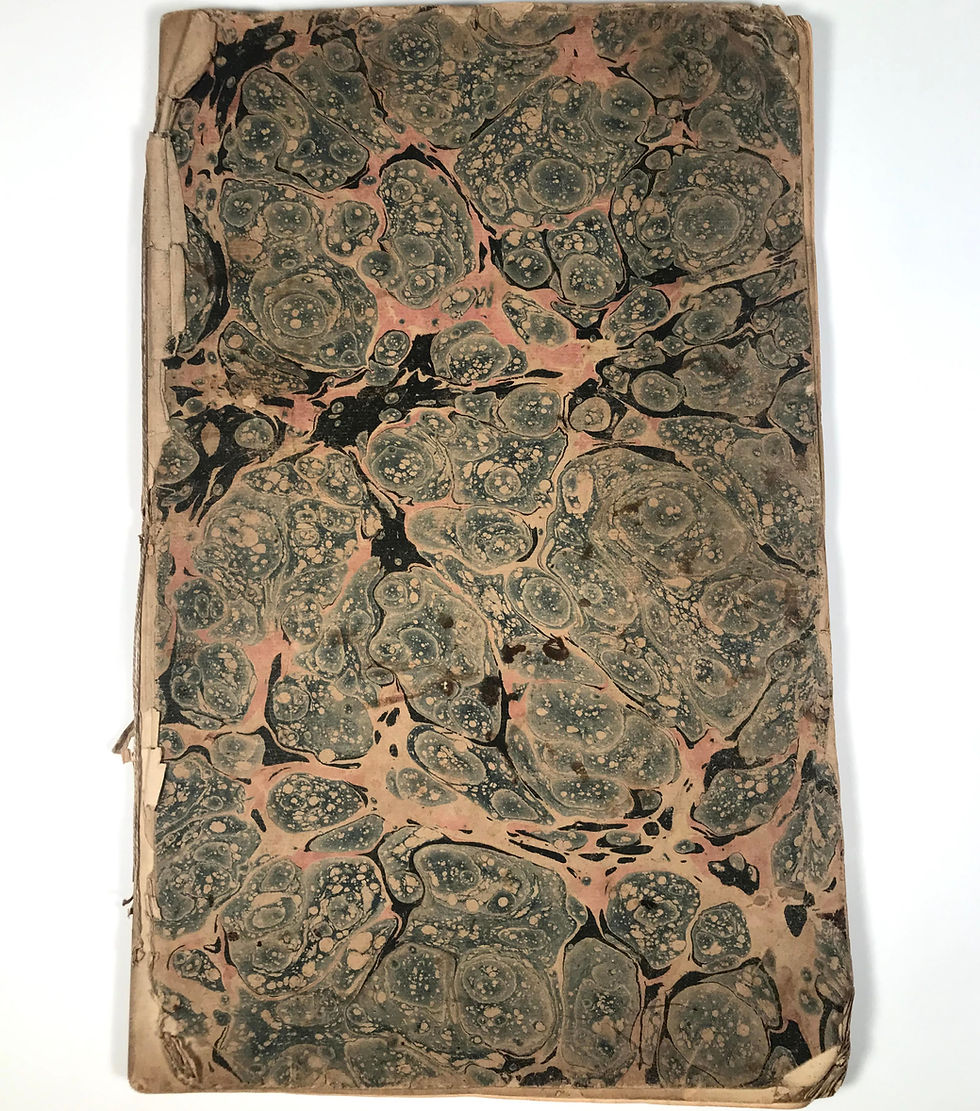
Marbled cover of Ebenezer Bliss' Math Copybook

Book measures approximately 13" x 9"


ree

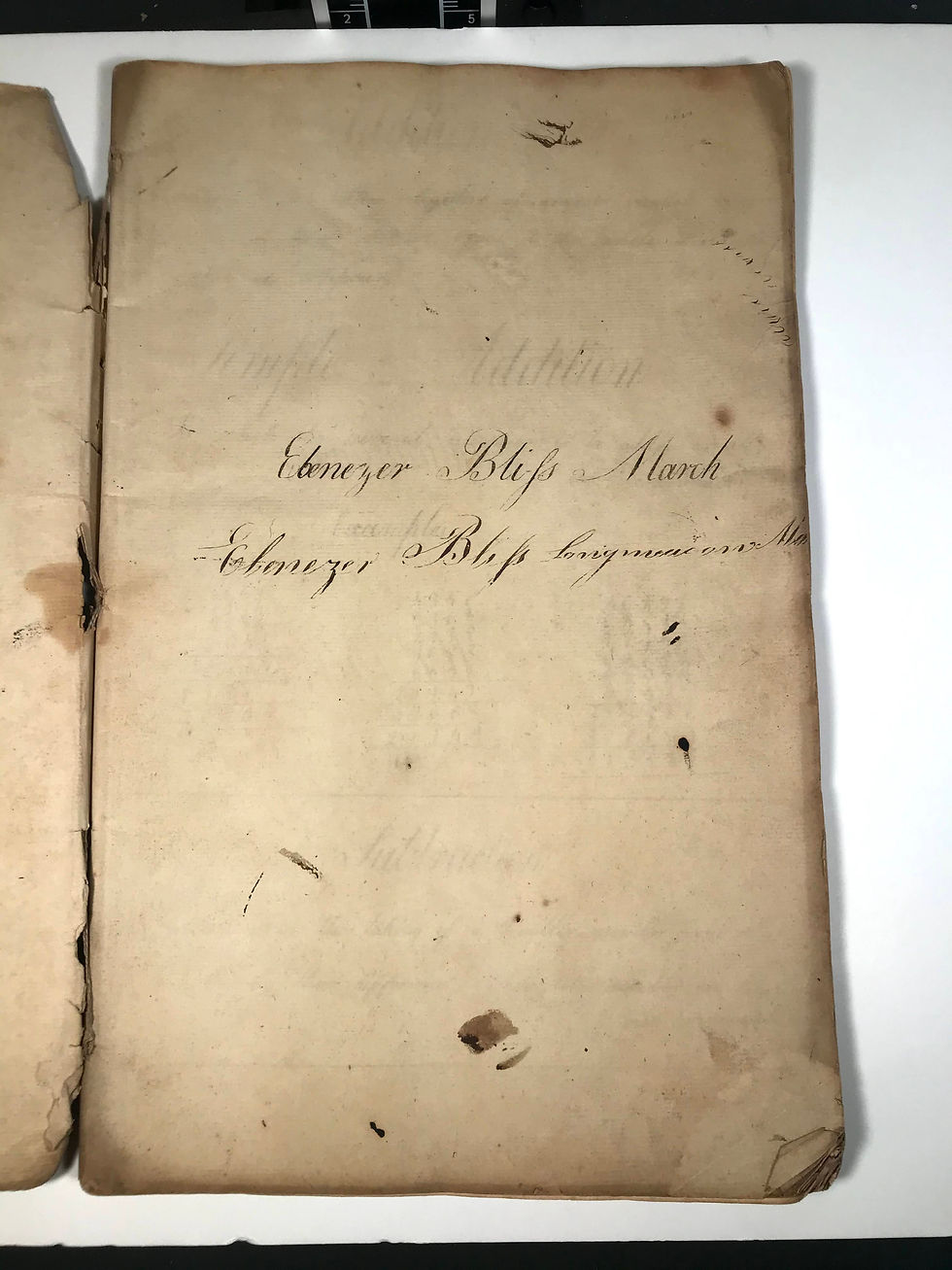
Ebenezer Bliss- Longmeadow


ree

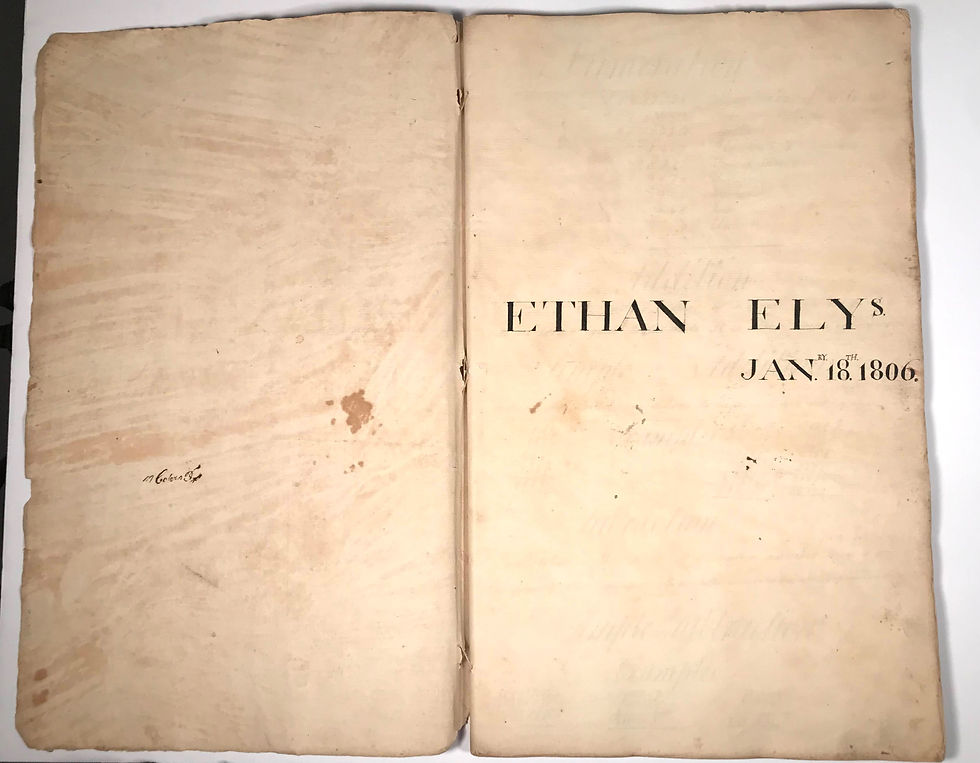
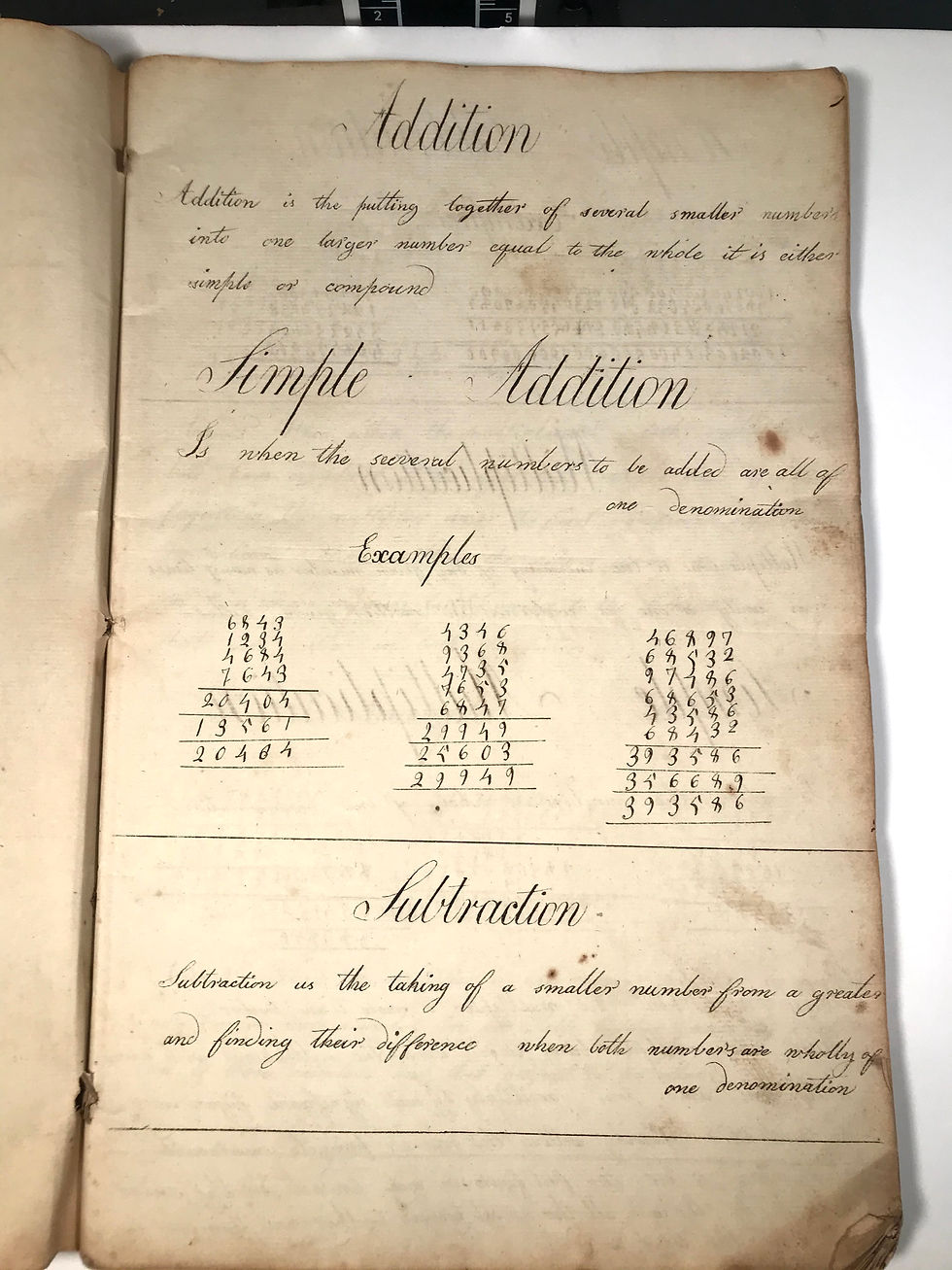
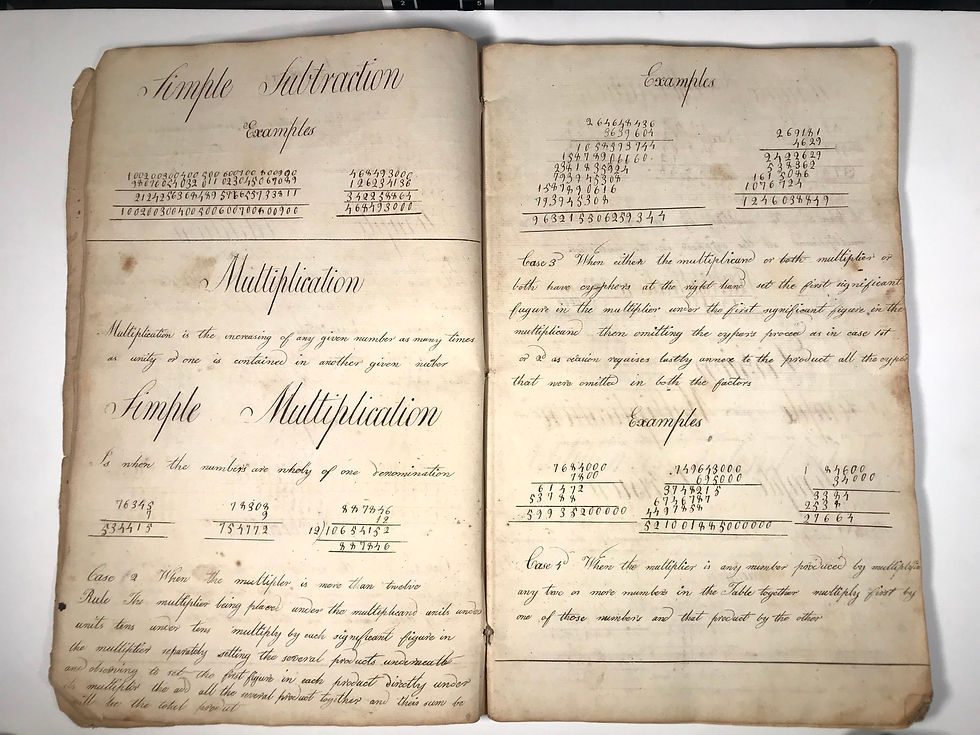
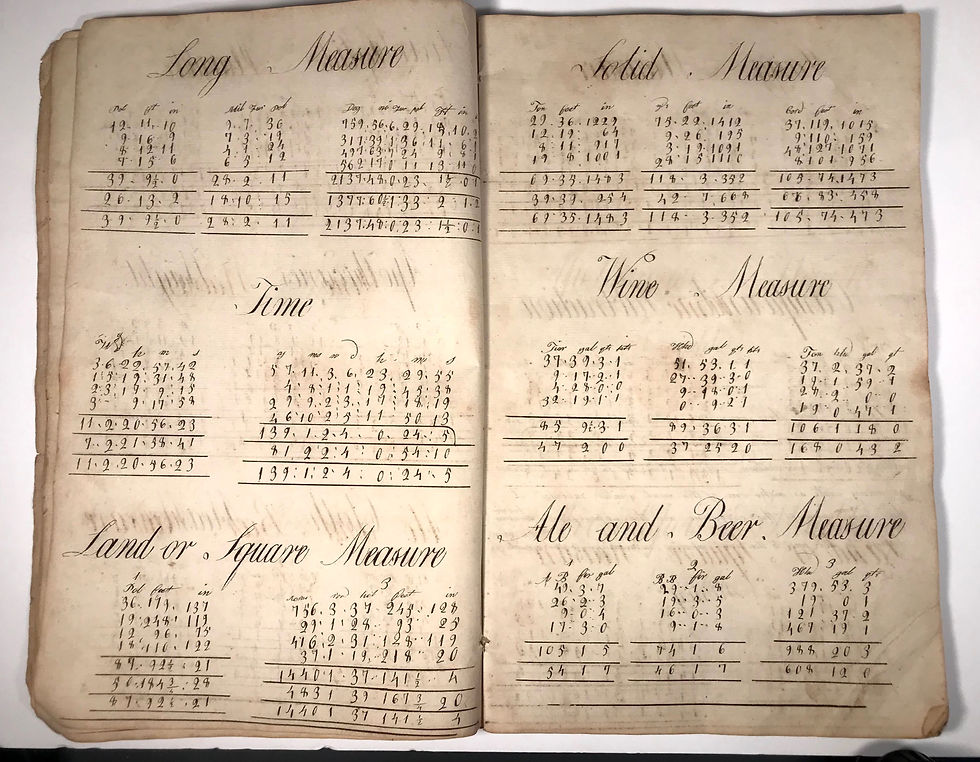
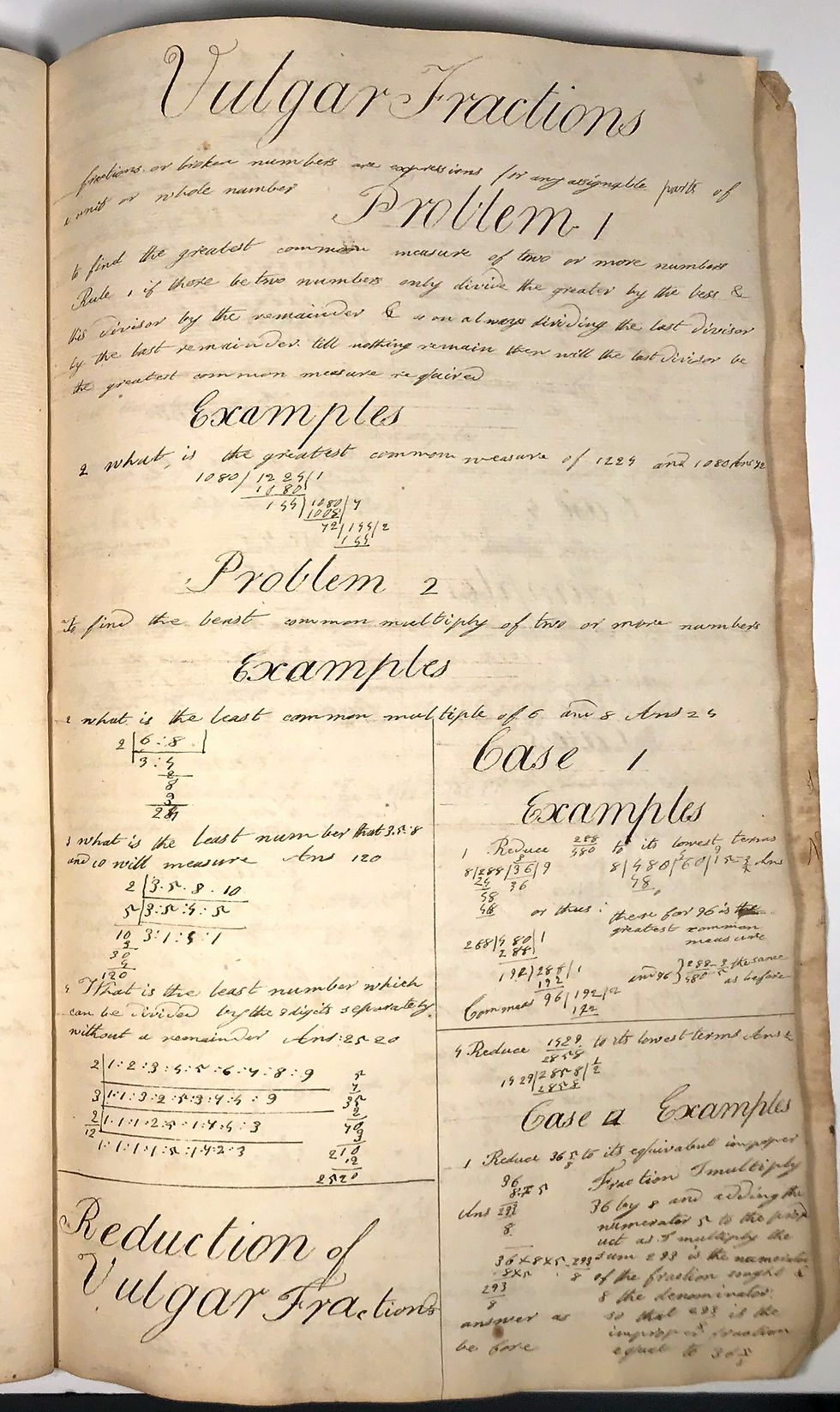
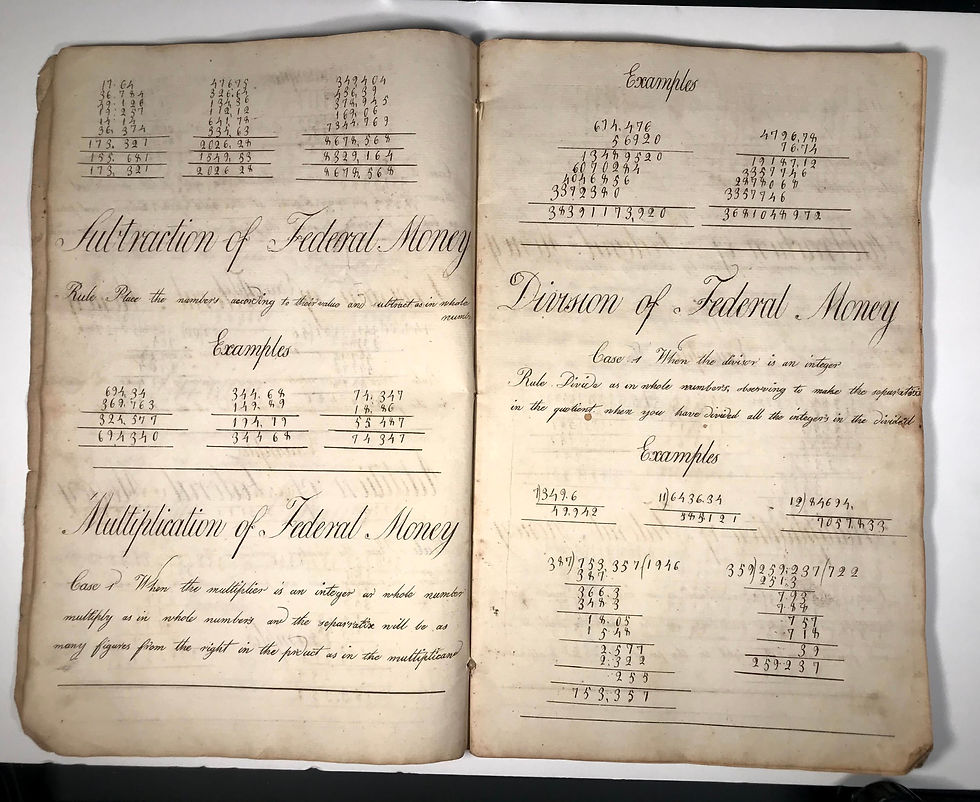
These two copybooks from the archives of the Longmeadow Historical Society are true marvels of “old math.” One c. 1810 belonged to Ebenezer Bliss (1795-1868) and the other dated 1806 belonging to Ethan Ely (1791-1875) - both of Longmeadow. The beautiful artistry of the penmanship aside, young Mr. Bliss and young Mr. Ely used their copybooks to collect and demonstrate their understanding of mathematical concepts that must have been taught in their Longmeadow District Schools in the first decade of the 19th century. They begin simply enough with addition - defining the concept and giving examples. Then they move through subtraction, multiplication, division. They then move onto applying these techniques to “Federal Money.” This is followed by the measurement terms and related math of a variety of items such as Time, Land, Solids, Wine, Bee & Ale, and Cloth. They progress through “Vulgar Fractions” and Decimals and into the important business of calculating Interest and even the math of Bartering. No algebra or calculus is included - just the type of math that would benefit the new nation’s farmers and merchants and other ordinary citizens.


ree

"Addition is the putting together of

several smaller numbers into one larger number"


ree

Definitions and Examples of Simple Subtraction and Simple Multiplication


ree

Measurement Work


ree

Vulgar Fractions ... indeed!


ree

Work with Federal Money math

Both copybooks beautifully display the firm grasp each scholar had on the material. They must have been proud of their work to save these paper mementos of their school days.


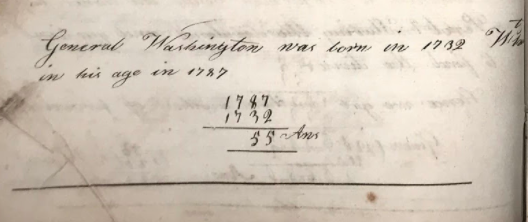
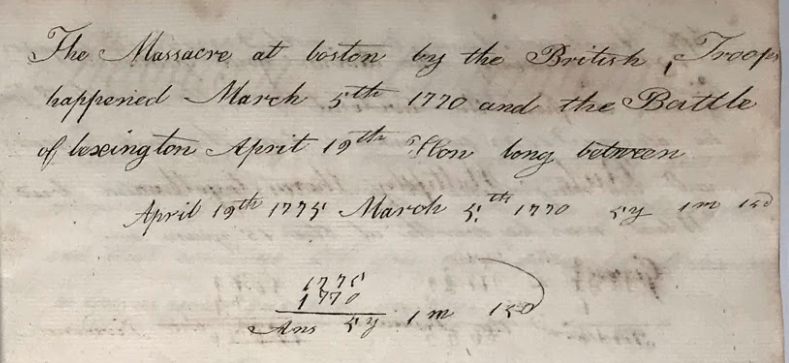
The word problems in Bliss’ book are striking reminders of the pride the nation felt in its recent triumph over the British: “General Washington was born in 1732. What is his age in 1787” (answer: 55 Ans). It is followed by “The Massacre at boston (sic) by the British Troops happened March 5th 1770 and the Battle of lexington (sic) April 19th. How long between April 19th 1775 March 5th 1770” (answer: 5yr 1m 15d)


ree

General Washington example from Ebenezer Bliss' book


ree

Revolutionary War timeline example from Ebenezer Bliss' book


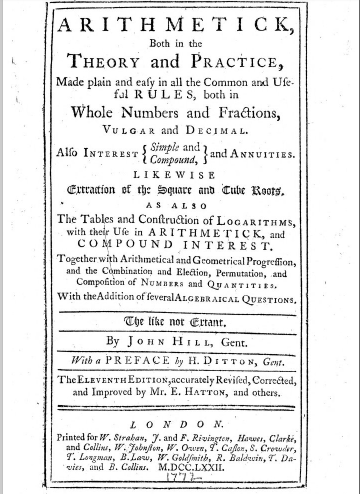
The language and organization of both books indicates that they are modeled on a popular Math textbook of the time called, “Arithmetick, Both in Theory and Practice” by John Hill. The preface of the book proclaims, “It appears to me, upon the Perusal of it, to be a curious piece: ‘Tis clean, methodical, and handsomely dressed: so plain, that the dullest person may learn by it; and so compleat, that he need learn no more.”


ree

We hope you enjoy a peek into these early 19th century school day relics from our archives.


Contributed by Melissa M. Cybulski, Longmeadow Historical Society Board Member

Originally published May 20, 2021


Updated: Jan 17, 2024


ree

Dr. Thomas L. Chapman (1817-1889)

Collection of the Longmeadow Historical Society


The town of Longmeadow has had many doctors in the past, some formally trained and others who gained their knowledge by mentoring with a more experienced physician. Thomas Luce Chapman (1817-1889) originally planned to study to be a missionary. During a prayer meeting, Chapman was badly burned when lightning "went down his back and [out] his boot, seriously affecting his heart."


One report noted, "A pretty full prayer meeting, supposed to number three hundred, were in attendance at the lecture-room [in the meeting house], when the lightning struck and descended the rod to the eaves. The rod had become detached from the building, and swung loose. There the lightning parted. One portion descended the rod to the earth, and there made a mighty display of its wonderful power. The other portion entered the lecture room...[and followed a system of stove pipes from the second floor to the first floor] and passed out through the underpinnings."...several were severely injured. (From the History of Pittsfield (Berkshire County) Massachusetts, 1876).


ree

Inspired by his brush with death, Chapman decided to study medicine at the Berkshire Medical Institute in Pittsfield, MA. At the time, medical treatment was primarily an attempt to determine which of the four humors in the body were out of balance by blood-letting, blistering, and the administration of purgatives and emetics. When Chapman studied at the Berkshire Medical Institute, formal study at a medical school was not a large part of most doctors' professional preparation. As late as the Civil War, only 50% of all doctors had graduated from a medical school. The rest had become doctors by "reading" with an established local doctor. Chapman graduated from BMI in 1842 at the age of 25. Chapman came to Longmeadow to practice medicine after his graduation.


ree

"By Medicine and Medical Attendance"


The California Gold Rush began January 24, 1848 when gold was discovered at Sutter's Mill in Coloma, CA. Thomas Chapman joined thousands of others who went west searching for treasure. He left on February 5, 1949 on the steamer S.S. Crescent City bound for the Isthmus of Panama, carrying with him a letter of recommendation from the Reverend Samuel Wolcott of Longmeadow. While thousands of others were stranded at Panama awaiting passage up the Pacific coast, Chapman hired on as the ship's physician on the S. S. Oregon, bound for San Francisco.


ree

After returning to Longmeadow, sadly without a fortune in gold, he married Charlotte Langdon in 1850. He and Charlotte lived at 788 Longmeadow Street. The Chapmans had stillborn twins, and then lost a six-year-old, Lillie, to "Scarlatinna" or scarlet fever, which was one of the leading causes of death in children at the time.


ree

788 Longmeadow Street


Doctor Chapman tended to the healthcare of Longmeadow residents for nearly thirty years. He as also elected to the state senate in 1863. After his wife, Charlotte, died in 1874, he remarried to Mary Chapin of Springfield, the daughter of Marvin Chapin, proprietor of the Massasoit Hotel.


Mary kept a diary, and recorded the remarkable life of her husband. The reverse of the wedding photo dated December 27, 1876 included a description of her wedding dress "the lace...was combined with a garland of apple blossoms and draped on the skirt..wedding dress of pearl gray silk." She described their winter wedding: "I have had often in mind the events of our wedding day...Our departure in an open sleigh, with our trunk on behind, gliding over the beautiful snow--under the brilliant moon to our home."


ree

Dr. Chapman and his second wife, Mary Chapin, 1876


Early medicine, and Thomas Chapman's interesting life is featured in an exhibit at the Storrs House Museum, home of the Longmeadow Historical Society, along with stories of other interesting characters from Longmeadow's past, including gravestone carvers, and early merchant, and artist and a pigeon racer. 


Contributed by Betsy McKee/ Al McKee, Longmeadow Historical Society Board Members


Originally published June 3, 2021


Contact

Contact us to learn more about our collections, upcoming events, and visiting the Storrs House Museum.

Address

697 Longmeadow Street Longmeadow, MA 01106

  • Facebook
  • Instagram
  • X

413-567-3600

© 2025 by Longmeadow Historical Society. 

Address: 697 Longmeadow Street 

Longmeadow, MA 01106

Email: info@longmeadowhistoricalsociety.org 

Phone: (413) 567-3600 

The contents of this website are the property of the Longmeadow Historical Society and may only be used or reproduced for non-commercial purposes unless licensing is obtained from the society.

The Longmeadow Historical Society is a 501(c)(3) charitable organization

bottom of page